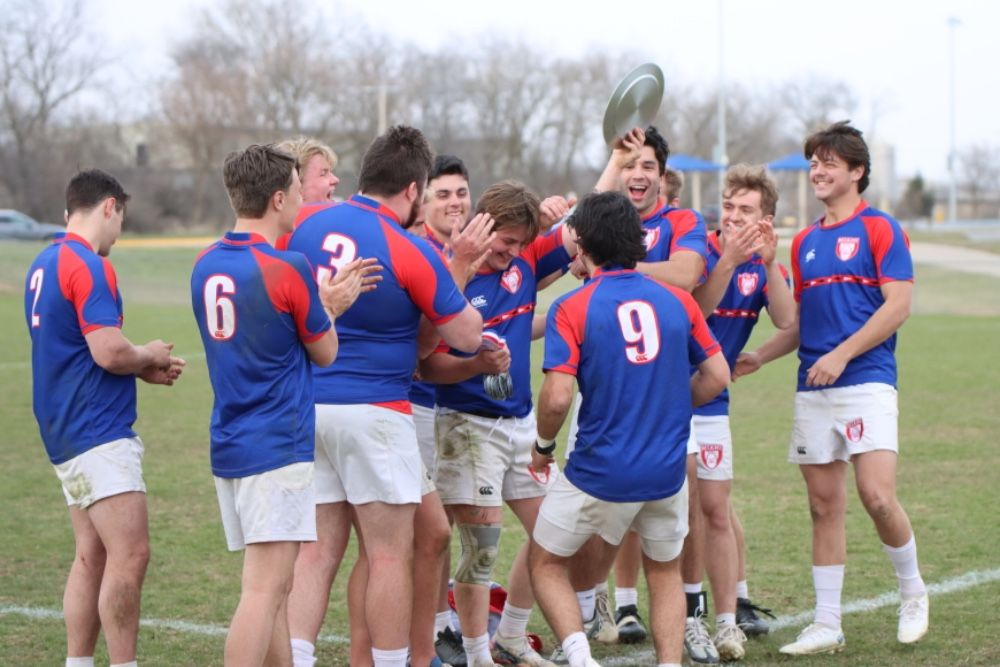
Each Tuesday and Thursday afternoon at Ditmer Field, the quiet edge of campus fills with the steady rhythm of contact, communication, and controlled intensity. Cleats lace up, drills run, and chants roar as the Miami University Rugby Football Club, commonly known as “the Reds,” gathers for practice.
As enthusiasm around Miami Athletics continues to grow, one of our lesser-known sports is building consistent momentum. Though competing at the club level, the Miami rugby program has built a championship standard, including two consecutive trips to the National 7s Collegiate Rugby Championship.
With the spring season underway, the energy continues.
Two Seasons, One Standard
Unlike many sports that occupy a single semester, rugby competes year-round.
In the fall, teams play 15s, the traditional format featuring 15 players per side. The game emphasizes structure, physicality, and endurance, with scrums and set pieces that demand coordination and technical precision.
In the spring, the focus shifts to 7s, a faster-paced variation played with just seven players on the same size field. With more space and fewer athletes, speed and quick decision making define the match.
“Seven-a-side is a lot quicker,” said Nicholas Stanis, a third-year prop from Cincinnati. “There’s more space, so everyone has to be ready to move.”
And because rugby spans both semesters, there is little downtime. As one season transitions into the next, preparation continues.
“We’re pretty much always in it,” said Brady Koschik, a second-year prop from Hinsdale, Illinois. “There’s always something to work toward.”
Different Paths to the Same Position
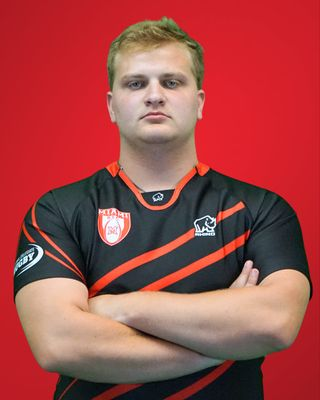
Nicholas Stanis ‘27 from Cincinnati, arrived at Miami with rugby experience from St. Xavier High School. Now competing as a prop — a forward position responsible for anchoring scrums and setting the tone physically — Stanis brings both technical understanding and leadership to the field.
“We take a lot of pride in what we do,” Stanis said. “When we step out there, we’re representing Miami.”
For him, the transition to collegiate rugby meant maintaining a competitive standard while adjusting to a faster pace of play and increased responsibility. Still, what keeps him invested is the culture of the team itself. He describes Miami Rugby as “fun, explosive, and gritty,” a combination that balances competitiveness with camaraderie.
Brady Koschik ‘28 from Hinsdale, Illinois, took a different route. A former wrestler and football player, he discovered rugby after arriving on campus. He now competes as a prop as well, applying leverage, balance, and physical control from his wrestling background to the demands of the position.
“You really have to trust the guys next to you,” Koschik said. “If everyone’s locked in, it works.”
Since joining the team, Koschik says rugby has shaped far more than just his athletic development. The structure and accountability of the program have given him a close-knit community on campus, pushed him to grow physically and mentally, and helped him carry that discipline into the classroom as well.
Though their paths into the sport differ, both players contribute to the same competitive expectations that define the program.
Intensity that Builds Connection
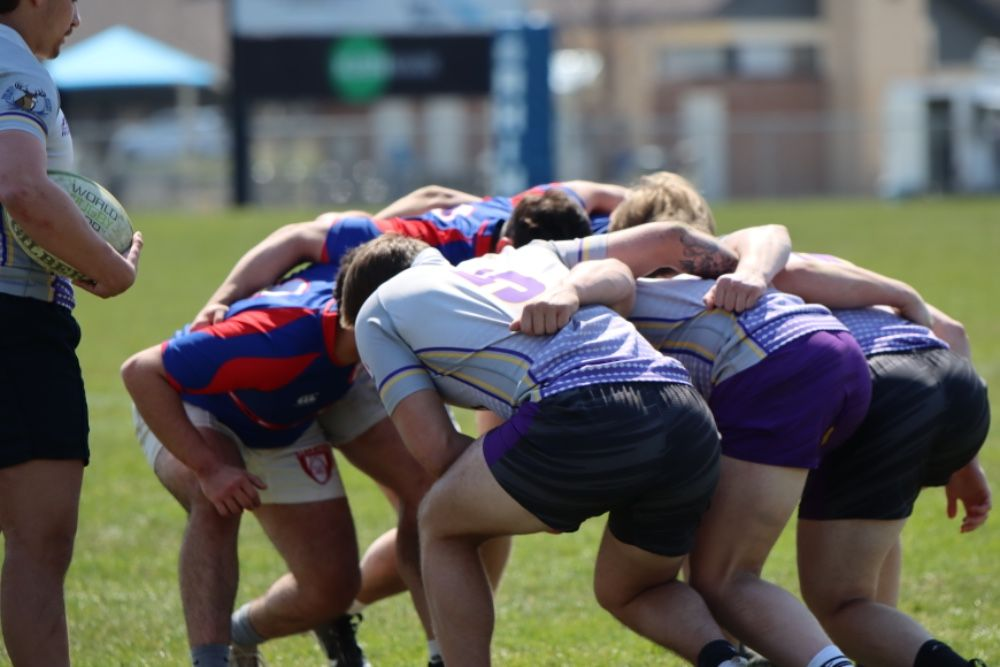
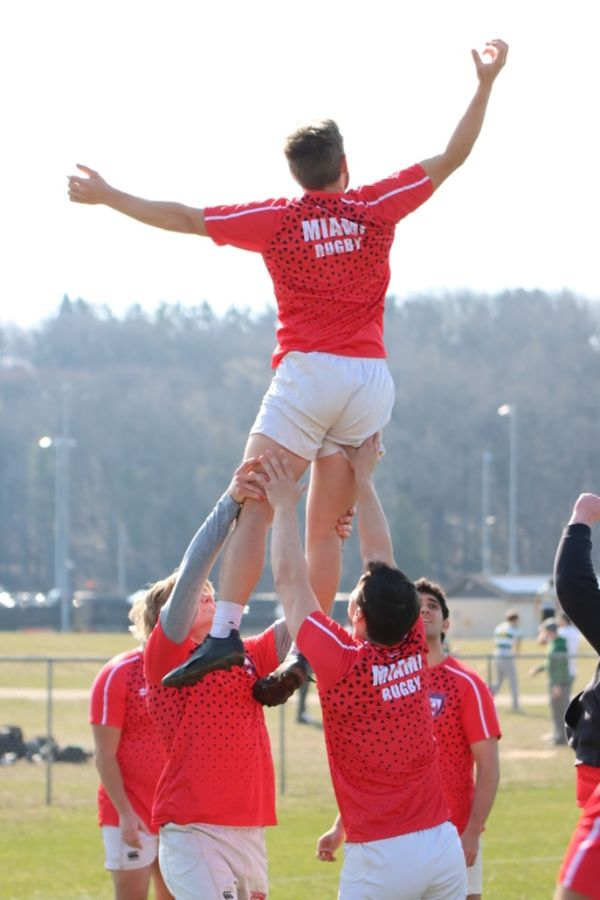
Miami Rugby participating in a “bind” with the other team.Miami Rugby engaging in a common lift called a “lineout.”
Rugby is demanding by nature. In scrums, players bind shoulder to shoulder. In tackles, they rely on communication and quick recovery. Physicality requires trust, and that trust is built long before game day.
Players spend hours together outside of practice on bus rides, at team events, and during tournaments. The time invested off the field strengthens communication and cohesion on it, creating a group that plays with purpose while maintaining a light-hearted environment.
Part of what makes that environment possible is the accessibility of the sport itself. Rugby requires limited equipment, and there is a position suited for nearly every body type and athletic background. Speed, strength, agility, and strategy all have a role, allowing athletes from different experiences to contribute in meaningful ways.
In recent years, the team has also grown under its new coach. “He’s really elevating the team,” Stanis said. “We’re taking it a lot more seriously now, but it’s still, at the end of the day, a social club. We practice hard, play hard, and then have a good time with each other afterward.”
A Team Worth Watching
Rugby is fast, physical, and exciting, with big hits, explosive plays, and nonstop action.
“[Rugby] has the pacing and technical rules of soccer, with the physicality of football or hockey,” Stanis said. “There’s always going to be something interesting going on.”
From scrums to lineouts to Garryowens, every position has its own moments — and its own fun terminology — making the game unpredictable and dynamic. And you do not need to know every rule to enjoy it. The speed, contact, and constant movement make it easy for first-time fans to follow along and get swept up in the energy.
Coming Up!
If this is intriguing to you, good news! The Miami University Rugby Football Club will be hosting their first ever home 7s Tournament, “Brick Street 7’s” on March 21.
The Reds are hoping to add one more win to their streak and looking toward a three-time national championship run.
The combination of intensity and connection is what defines the program. Come out to the home match and see what those words look like in action.
Keep an eye out for the latest updates on Instagram: @miamirugby